Euro Trip: Part -2 : Iceland
Transition: Paris to Iceland
On October 5, we flew from Paris to Keflavík Airport, Iceland, on PLAY Airlines. This marked a clear shift in the character of the trip — from crowded cities to open landscapes.
We landed in Iceland around 3:00 p.m. From the airport, a shuttle took us to the car rental office (I’ll share rental details separately in another post).
I had originally booked a manual transmission car, but at the counter we were unexpectedly upgraded to a Peugeot 2008 with automatic transmission, at no extra cost. Initially, I wasn’t comfortable — I hadn’t mentally prepared for driving an automatic. That hesitation didn’t last long. Within a short time, it turned out to be far more comfortable, especially for longer drives.
Iceland, like most European countries, drives on the right side of the road, with left-hand steering. This was my first extended drive in such conditions — and easily the most adventurous part of the trip so far, especially with family in the car.
To stay connected, I opted for the in-car Wi-Fi dongle with a local SIM, even though I already had an Airtel international roaming plan. This was a conscious redundancy choice — navigation and connectivity are too important when driving through remote areas.
Our drive to the stay in Tungufell took about 2 hours and 15 minutes.
The driving itself wasn’t difficult, but frequent roundabouts demanded constant attention. With steady pacing and caution, we reached safely.
The stay was exactly what I had hoped for — complete isolation. No visible houses on the horizon. Just open land and quiet. I liked it immediately. My wife, who usually prefers more crowded places, liked it too — which surprised both of us.
It felt like we had entered a different Europe altogether.
Iceland – Day One: Fire, ice, and silence
We started early, around 8:30 a.m., heading out into the Icelandic landscape for the first time.
Our first stop was Gullfoss.
The cold was immediate and intense — not just chilly, but biting. The waterfall itself is powerful and raw, and the spray combined with the wind makes you feel how exposed the land really is. We spent about 30 minutes there.
From Gullfoss, we drove to the Geysir area.
This was surreal. Hot water erupts from the ground every few minutes while ice and frost sit just meters away. The contrast — fire and ice coexisting — feels uniquely Icelandic. We stayed for about 45 minutes, watching multiple eruptions.
Next was Þingvellir National Park.
This is where the European and North American tectonic plates meet. Standing there, the landscape feels less scenic and more geological — quiet, stretched, and ancient. We spent around 40 minutes walking through the park.
From there, we headed to Kerið Crater, formed by volcanic activity.
There is an entry fee of 600 Icelandic Krona per person. The crater is compact, vivid, and sharply defined — red rock, blue water, and silence.
We ended the day at the Secret Lagoon.
Soaking in naturally heated geothermal water after a cold, wind-heavy day was deeply satisfying. Steam rose into the air, the ground was warm beneath us, and the surrounding landscape remained stark and quiet.
That contrast — cold air, warm water, open land — captured Iceland better than any photograph.
Nightfall: Northern lights
That night, we witnessed the Northern Lights.
They didn’t appear the way they often do in photographs. To the naked eye, they were mostly white, with a faint green tint — subtle, not explosive. It took a moment to realise what we were actually seeing.
Using the camera in manual / pro mode, the colours became clearer. Long exposures revealed the green more distinctly, while the sky behind was filled with stars — densely packed, with almost no visible gaps. It felt less like a sky and more like depth.
The cold at night was sharp and persistent. Standing still for long stretches wasn’t easy, but we managed to capture a few photographs before retreating indoors.
It wasn’t dramatic.
It was quiet, slow, and unreal — the kind of experience that doesn’t announce itself, but stays with you.
Iceland – Day Two: Water, ice, and scale
We started early.
Before heading out, we filled petrol at a nearby station. Fuel stations in Iceland are self-service, and payments are straightforward. I used an Axis Bank multi-currency card, which worked smoothly. Credit cards work just as well — cash isn’t needed.
Our first stop was Seljalandsfoss.
We spent about 40 minutes there. The waterfall is elegant and accessible, and the ability to walk around it makes the experience feel interactive rather than distant.
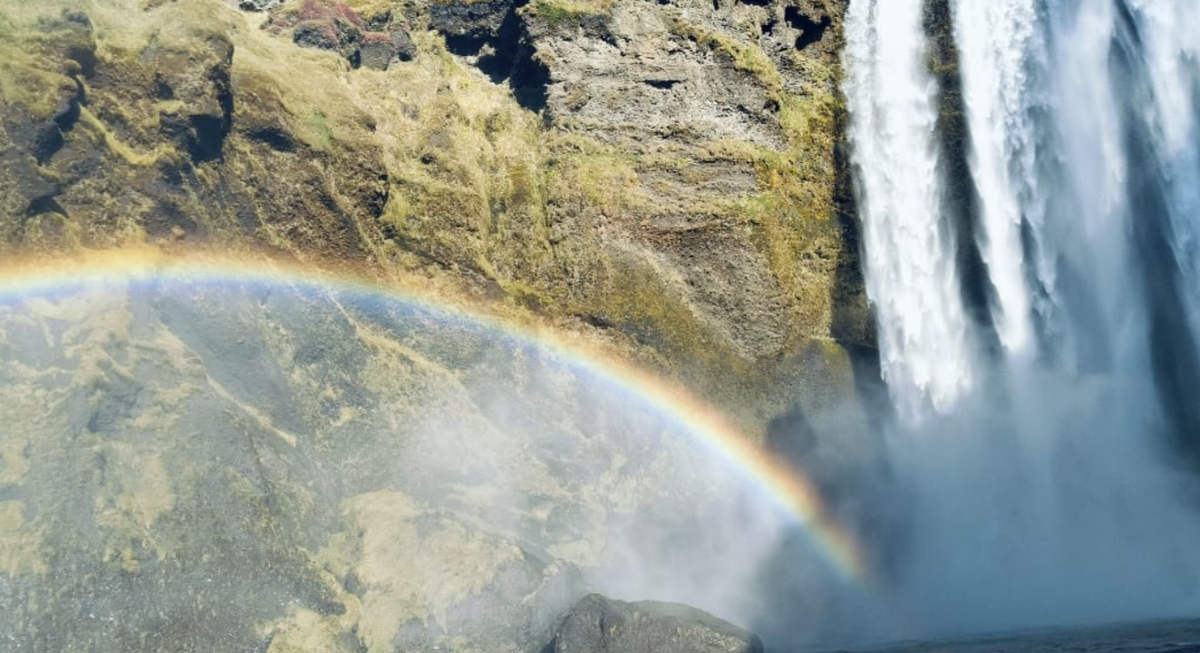
From there, we drove to Skógafoss.
This one felt more powerful. As the mist rose, a rainbow appeared, forming briefly and then fading — a moment that felt entirely unplanned and surreal.
Next was Sólheimajökull.
We spent more time here, walking closer to the glacier and taking a longer break. Lunch was simple but memorable — Spanish langos, warm and satisfying in the cold air.
After that, we headed to Dyrhólaey, stopping at the mountain-top viewpoint. The perspective from above — cliffs, ocean, and open sky — felt expansive and quiet.
The final stop of the day was Reynisfjara.
The contrast was striking — black volcanic sand meeting deep blue ocean. At the time, the parking area near the beach was under renovation, so we had to park farther away and walk about 1.2 km each way. Even with the extra walk, the beach was worth it — stark, dramatic, and unlike anywhere else.
We reached our stay late that night.
Iceland, in just two days, had delivered more landscape than many trips manage in weeks.
Departure: Closing the Iceland chapter
On Day Three, we checked out early, drove back to the airport, returned the car at the rental office, and boarded our flight to Zurich.
That marked the end of Iceland — a place defined not by movement or monuments, but by space, silence, and scale.
Iceland tips: driving safely
Driving and logistics
- Renting a car is strongly recommended.
Iceland is designed for self-driving. Many of the best places are spread out, and public transport won’t take you where you want to go at your own pace. - Always save the rental office contact numbers.
Connectivity is good, but issues in remote areas are best handled quickly with direct support. - Respect speed limits strictly.
Speed cameras are everywhere. Our car even displayed the speed limit on the dashboard, and the speedometer appeared to read about 5 km/h higher than actual speed — likely a built-in safety buffer to prevent fines. Still, don’t rely on it. Drive conservatively. - Be extra cautious at roundabouts.
They can be challenging, and local drivers may honk. Ignore it. Safety matters more than pace. - Fuel planning is important.
Petrol stations can be sparse in remote areas. Never let the tank drop below half. Fuel stations are self-service, and credit or multi-currency cards work smoothly. - Carry food and water in the car.
You’ll often drive long stretches with no shops or cafés. Simple snacks make a big difference. - Parking fees are common.
Many popular spots require online parking payment. No one may physically check, but cameras do. Always pay — fines are automatic and expensive.
Iceland budget
For our family of 4 members
- Flight (Paris → Iceland): ~₹70,000
- Accommodation: ~₹60,000
- Car rental: ~₹35,000
- Other expenses: ~₹35,000
(fuel, parking, food, entry fees, incidentals)
Total (approx.): ₹2.0 lakh INR
For what Iceland offers — scale, isolation, and raw nature — the cost felt justified.